Upside down on your RV loan? Your options
Upside down on your RV loan? Calculate negative equity, get a payoff quote, compare selling, refinancing or keeping it, and see how Texas liens work.
Published · By the Cash For RV team, Houston
If you have an upside-down RV loan, your main options are to keep paying, reduce the principal faster, seek refinancing, or sell and cover the payoff shortfall. Trading or surrendering the RV does not automatically erase negative equity. Start by comparing a current lender payoff quote with a realistic value for your RV.
Negative equity describes the gap between debt and value, not whether you have missed payments or damaged your credit. The explanations below can help you prepare questions, but they are not financial or legal advice. Confirm loan terms with your lender and Texas title requirements with TxDMV or your county tax office.
The short version
- Negative equity equals the amount by which your current loan payoff exceeds your RV's realistic value.
- A lender payoff quote can differ from the balance printed on your monthly statement.
- Extra principal payments reduce debt, while refinancing changes loan terms without erasing the shortfall.
- Selling an underwater RV normally requires you to cover the difference at closing.
- Voluntary surrender can leave a deficiency balance and adverse credit reporting.
How do you calculate negative equity on an RV loan?
Calculate your RV equity by subtracting the current loan payoff from its realistic current value. CFPB describes negative equity as owing more than a vehicle's trade-in value; the same value-versus-debt calculation helps you evaluate an RV.
Equity = realistic current value minus current payoff. A negative result is the shortfall. Hypothetical worked example: suppose an obtainable as-is offer is below your lender's payoff quote. Subtract the payoff from the offer to calculate negative equity, then reverse the subtraction, payoff minus offer, to identify the amount needed to close that gap.
Use comparable RVs and multiple actual offers or estimates, not just advertised asking prices. Match RV type, model year, condition and equipment as closely as possible. Our guide to estimating your RV's current value explains what to compare.
J.D. Power's RV guidance identifies depreciation, maintenance and condition as important value factors. Water intrusion or nonworking equipment can materially change the result. A general RV depreciation explanation provides context, but it cannot replace an assessment of your specific unit.
How do you get an accurate RV loan payoff quote?
Request a dated payoff quote directly from your lender or loan servicer rather than relying only on your statement balance. CFPB explains that accrued interest, late fees and other charges can make the payoff different from the balance you see online.
Tell the lender you are evaluating your options and ask how to obtain written payoff instructions. You do not need to commit to a transaction just to learn what you owe. If the quote expires before you act, request an updated one.
Confirm the following details before treating a payoff figure as final. A credit union's private-party RV financing guidance also emphasizes settling payment and title-delivery instructions before closing.
- The exact payoff amount and the date through which it remains valid.
- Any applicable early-payoff charges under your contract.
- Verified payment instructions and the lender's confirmation procedure.
- Whether the title is paper or electronic and where the released title will go.
Can keeping the RV or making extra principal payments help?
Keeping the RV and paying down the loan can reduce the debt side of negative equity if the payments are affordable. It does not guarantee positive equity by a particular date because the RV's future value can also change.
CFPB explains that payments generally go toward fees and accrued interest before principal. The entire monthly payment therefore does not necessarily reduce your outstanding principal. Check your statements to see how much actually reaches the debt balance.
Extra principal payments may shorten repayment and reduce interest, but they do not increase the RV's market value. Before sending extra money, review your contract and ask the servicer how to direct it to principal rather than simply advancing a payment due date.
Review the next statement to confirm the allocation. Prepayment provisions vary by lender, so check for penalties instead of assuming early payoff is always free. Compare the ongoing payment and ownership expenses with what you can realistically afford.
Will refinancing an RV loan fix negative equity?
Refinancing replaces your existing RV loan with new financing, but it does not by itself forgive principal or increase the RV's value. A lower payment may help your monthly budget without solving the underlying negative equity.
A credit union's RV refinancing guide explains that improved credit or income may help you qualify for better terms. Approval and savings are not guaranteed. Ask about loan-to-value limits, collateral age, repayment term and restrictions related to full-time RV use.
Compare the remaining cost of your current loan with the full proposed refinance cost. Include interest, fees and any early-payoff charges, not just the advertised payment. Extending repayment can lower the monthly bill while keeping you in debt longer.
If the RV is worth less than the payoff, ask whether the lender will finance that entire amount or require you to reduce the balance first. Cash For RV does not refinance loans or provide financing.
Does trading an upside-down RV erase what you owe?
Trading an upside-down RV does not erase negative equity when the shortfall is added to replacement financing. It moves the unpaid gap into another loan rather than making it disappear.
CFPB warns that a dealer's promise to pay off an existing vehicle loan may mean the negative equity is included in the new financing contract. Rolling that shortfall into the replacement loan increases the amount financed and the interest paid over its life.
Read the proposed contract for the trade allowance, old payoff, negative equity and total amount financed. Do not judge the arrangement only by its monthly payment. Our guide to trading versus selling your RV explains the differences.
After a completed trade, CFPB recommends contacting the old lender to confirm the previous loan was actually paid off. A dealer's promise and a confirmed payoff are different things. Any replacement purchase should be evaluated separately from the old debt.
What happens if you cannot afford your camper payment?
Contact your lender promptly if your camper payment becomes unaffordable, because an agreed payment change may be available before surrender or repossession. FTC says a lender may agree to a delay or revised schedule; get any change in writing.
After hurricane-related hardship, ask whether the lender offers disaster-related deferrals, revised repayment plans, grace periods or fee relief. These are requests, not automatic Houston-area benefits. Clarify how any change affects interest, future payments and the payoff amount.
Voluntary surrender means returning the RV to the lender, but FTC warns that it does not automatically cancel the debt. It may reduce some repossession-related fees while leaving you responsible for a deficiency.
An RV repossession deficiency balance can include unpaid debt and certain contractual expenses, less the lender's sale proceeds. FTC says deficiency lawsuits are possible in most states when applicable rules were followed. Texas law and your contract matter, so consult an attorney about your situation. Late payments or repossession may still be reported after voluntary surrender.
How can you sell an RV with a lien in Texas?
You can arrange to sell an RV with a loan still outstanding, provided the payoff, any shortfall and the lien release are coordinated. You do not always have to pay off the entire loan before arranging the transaction.
Compare the agreed purchase price with a current payoff quote. If the payoff is higher, you normally must fund the difference before the lien can be released, unless the lender expressly approves another arrangement. Direct payment to the lender does not forgive that gap.
Before closing, verify the titled owners, matching VIN, recorded liens and required signatures. Establish payment instructions, title delivery and when possession changes. Our guide to selling an RV you still owe money on explains the payoff arrangement.
For paper-title lien removal, TxDMV lists the title, lien-release documentation and Form 130-U. With an electronic lien, the lender coordinates release with TxDMV, which converts the record to a paper title and mails it to the recorded owner or a third party. Texas lienholders must release a lien within 10 days of receiving payoff, but that does not promise immediate paper-title delivery. Confirm the process with your lender and county tax office, and retain payoff and Texas title-transfer records.
Selling your financed RV to Cash For RV in Greater Houston
Cash For RV can buy a financed RV and pay the lender directly, but you must cover any amount owed above our agreed offer at closing. We only buy RVs in Greater Houston; we do not sell replacements, take trade-ins, refinance or make loans.
Share details and photos through our form, a call or text to request a cash offer for your RV. We review them and often offer the same day, then arrange a quick in-person look wherever the RV is locally. If its condition matches your description, the offer stands; significant undisclosed issues may change it, and you can decline.
At signing, we coordinate lender payoff and title paperwork, pay any equity to you, and tow or drive the RV away at no cost. There are no fees, commissions or obligation. See how our purchase process works. Damaged and non-running RVs are considered, although some units are not a fit.
Frequently asked questions
Can someone take over my RV loan payments?
An informal payment takeover does not release you from responsibility for the loan. Even if another person possesses the RV and sends payments, you remain responsible unless the lender approves a formal arrangement that changes your obligation. Ask whether loan assumption is available and obtain the lender's written requirements before handing over the RV or title.
Can I refinance if I am behind on RV loan payments?
Approval depends on the lender's requirements, your creditworthiness, the RV's value and other loan conditions. Being behind does not establish that refinancing will be available, and negative equity can limit how much a new lender will finance. Contact your current servicer about payment options and ask prospective lenders about eligibility before relying on a refinance to resolve the problem.
What if roof and slide damage make my RV worth much less than I owe?
Get a realistic as-is valuation that accounts for the roof, slide and any water damage, then compare it with a current payoff quote. The loan balance does not fall simply because the RV needs repairs. Before spending money, compare documented repair costs with a realistic estimate of the repaired value. Cash For RV considers damaged units, but an offer cannot erase a payoff shortfall.
Can an escrow service send payment straight to my RV lender?
Ask your lender and the proposed escrow provider whether they can coordinate direct payoff for your transaction. Do not assume every provider supports financed RV transfers. Settle the verified payoff instructions, any seller-funded shortfall, release conditions and title destination before depositing funds. Direct payment can keep payoff money from passing through the seller, but it does not eliminate negative equity.
How do I get out of an upside-down RV loan if I cannot cover the gap?
Without funds to cover the shortfall, a normal sale may not be able to close. Ask your lender about payment changes or any expressly approved alternative payoff arrangement, and obtain terms in writing. Keeping the RV, reducing principal or qualifying for refinancing may be options, but none guarantees immediate relief. Surrender can leave debt and credit consequences, so seek individual financial or legal guidance before deciding.
Sources
- TxDMV: Add or remove a lien
- CFPB: Trading in a vehicle that is not paid off
- CFPB: Paying interest or principal on an auto loan
- FTC: Vehicle repossession
- J.D. Power: How much do campers depreciate?
- Alliant Credit Union: Recreational vehicle loans
- Alliant Credit Union: RV loan refinancing
- People Driven Credit Union: Private-party RV loans
- Valley Credit Union: Cannot afford your camper payment?
Related pages
 SituationSelling an RV you still owe money onWe pay your lender directly, even if you're upside down.Read more
 GuideShould I trade in my RV or sell it?Trade-in, private sale or cash offer, plus Texas tax.Read more
 GuideHow much is my RV worth?Book values, comps, condition and what cash buyers pay.Read more
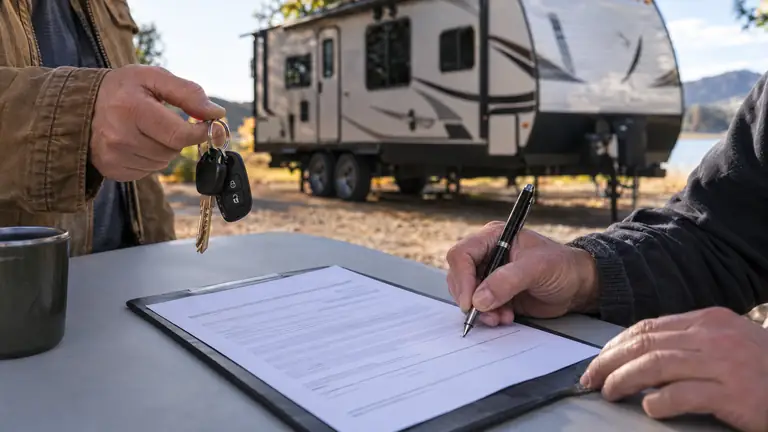 GuideTexas RV title transfer: the seller's paperwork, step by stepTitle, 130-U, lien release, VTN and plates.Read more
 GuideRV depreciation: how fast do RVs lose value?How value changes by age, type and condition.Read more
 Cash For RVGet a cash offer for your RVSend the details and photos, and get a no-obligation cash offer.Read more
Ready when you are
Get a real number for your RV, not a listing estimate.
Send a few details and photos. We'll come back with a cash offer, and if it works for you, we handle the paperwork and the pickup.