RV depreciation: how fast do RVs lose value?
How RV depreciation works by age and type, what slows it, why condition matters in Houston humidity, and how to check what your RV is worth.
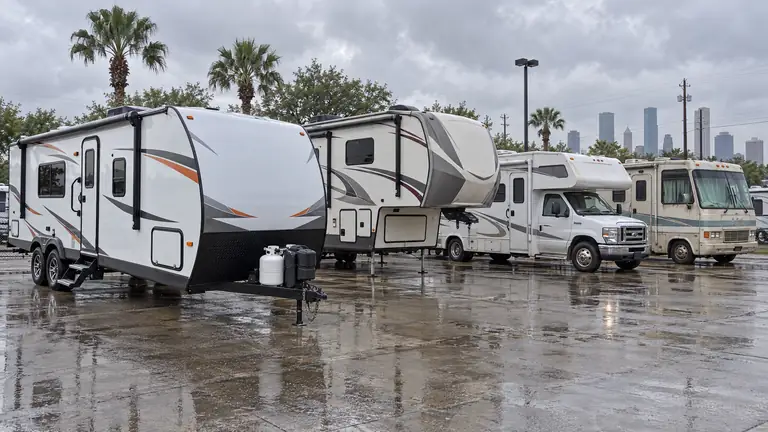
Published · By the Cash For RV team, Houston
RV depreciation is usually steepest early in ownership, then slows as the RV ages, but there is no fixed rate for every model. A marketplace depreciation guide updated November 17, 2025, estimates that Class A motorhomes can lose about 20–30% in their first year. Your RV’s actual decline depends on its purchase price, condition, demand and the market when you value it.
Published percentages can explain the general pattern, but they cannot price an individual RV. For a useful present-day estimate, compare the exact model with J.D. Power RV values and current local listings, then account for maintenance, equipment and damage.
The short version
- Published depreciation percentages are estimates tied to a particular RV type, time period and starting value.
- Annual depreciation and cumulative depreciation are different calculations.
- Class B vans and certain trailer brands have value-retention reputations, not guaranteed resale percentages.
- In Greater Houston, actual moisture damage matters more than an age-only calculator can show.
- Retail guide values, listing prices and direct purchase offers describe different valuation situations.
How does RV depreciation change by year?
RV depreciation by year typically follows a steeper early decline followed by slower losses, rather than an identical annual deduction. The marketplace guide updated November 17, 2025, says the largest drop usually occurs in the first year and most depreciation occurs within the first five years.
That guide gives an illustrative curve of 25% in year one, followed by 10% of the preceding year’s value annually in years two through five, and about 5% annually afterward. It explicitly says results vary greatly. This is an example, not a measured schedule you should apply automatically to your RV.
The calculation matters: later annual deductions apply to the remaining value, not repeatedly to the original purchase price. Cumulative depreciation measures the total decline from the starting value, while retained value describes what remains.
Published guides also use different timeframes. A separate marketplace valuation guide dated September 2026 says many RVs lose an estimated 20–30% in the first few years, rather than specifically describing first-year Class A losses. Those statements should not be merged into a universal curve.
How much do RVs depreciate by type?
RV depreciation by type varies, and published estimates should be treated as broad reference points rather than a ranking of today’s resale market. J.D. Power’s November 25, 2019, shopping guide provides historical estimates for several motorhome and towable categories.
For Class A motorhome depreciation, that J.D. Power guide estimates approximately 30% cumulative loss after three years of ownership. It also says a Class A can be worth less than half its purchase price after ten years, without establishing an exact retention percentage.
For Class C motorhomes, the same 2019 J.D. Power guide estimates about 38% cumulative depreciation after five years and just over 50% after ten years. The ten-year figure is the total loss from the starting price, not an additional loss added to the five-year estimate.
For travel trailer depreciation, J.D. Power’s 2019 guide estimates about 60% of the purchase price remaining after five years, equivalent to about 40% cumulative depreciation. For fifth wheel depreciation, it estimates about 45% cumulative loss after five years and 71% after ten years, roughly 70% in practical terms.
These historical estimates are not current appraisals. They also cannot establish the value of a particular camper van, Super C, toy hauler, pop-up or truck camper without model-specific comparisons and a condition assessment.
Which RVs hold their value best?
Some RVs have stronger value-retention reputations, but no type or brand guarantees the best outcome for every owner. The marketplace depreciation guide describes Class B campervans and smaller, high-demand models as tending to depreciate more slowly.
That supports a qualified Class B RV depreciation claim, not a universal retention percentage. The same guide identifies Airstream and Casita as makes that tend to retain value longer. Airstream depreciation still occurs, and a damaged example can perform worse than a well-maintained trailer with a less prominent reputation.
A marketplace valuation guide dated September 2026, presenting dealer insights, says diesel units typically retain value better than gas models, particularly tag-axle models. It also describes strong Class C resale demand and attractive aging of full-body paint. These are qualitative observations, not proof that every diesel pusher outperforms every gas coach or camper van.
Why do age-based calculators miss Houston RV condition?
An age-based calculator misses the difference between a protected RV and a same-year unit with leaks, moisture damage or neglected systems. Greater Houston’s humidity, heat and heavy rain make those differences especially important to inspect.
Winnebago explains that high humidity can cause wood to warp, expand and lose structural integrity, while encouraging mold. Its moisture guide also says cracks or separation in roof seals and caulk joints can let water enter or reach spaces between exterior panels, causing delamination.
The National Weather Service Houston/Galveston office identifies hurricane, storm-surge, rainfall-flooding, coastal-flooding, damaging-wind/hail and extreme-heat hazards. Ask about actual exposure and damage history rather than assuming every local RV has flooded. No fixed Houston weather deduction applies to every unit.
Age still matters, but how long RVs last and how well they retain value are different questions. A usable RV can have substantial depreciation, while an apparently clean interior may conceal damage.
- Check roof joints, window seals, gaskets and window weep holes for problems.
- Investigate musty odors, swollen wood, soft surfaces and water stains.
- Document known leaks, storm damage and completed repairs.
- Look for exterior panel separation or bubbling that may indicate delamination.
What can slow an RV’s depreciation?
Protecting condition and buying at an appropriate price can reduce avoidable value loss, although neither stops depreciation. Buying already used can also reduce exposure to the initial new-to-used drop because an earlier owner has already experienced it.
Winnebago recommends humidity monitoring, air conditioning, dehumidifiers and sound seals as moisture-management measures. These can protect the RV’s condition, but the manufacturer does not assign them a specific resale-value increase.
Maintenance records, roof and seal documentation, tire age and working appliances help distinguish your RV from superficially similar units. Addressing the cause of a stain matters more than concealing it.
Upgrades are not guaranteed to return their cost. The marketplace depreciation guide says useful equipment can improve appeal, while highly personalized fixtures, paint or layout changes may discourage buyers. Keep receipts, but do not assume every improvement adds its full cost to market value.
How do retail, wholesale and cash-offer values differ?
Retail, wholesale and cash-offer values describe different transactions, so they should not be treated as interchangeable prices. Retail estimates concern a consumer purchase context; wholesale generally concerns acquisition for resale; a cash offer is a specific buyer’s proposed purchase amount.
J.D. Power model valuation pages separately display Suggested List Price, Low Retail Value and Average Retail Value, along with option adjustments. Low Retail is still labeled retail, not wholesale or a guaranteed amount an owner can collect.
A buyer acquiring an RV for resale must allow for its condition, preparation needs and resale margin. There is no reliable universal subtraction that converts a retail guide figure into every buyer’s offer.
Private-sale asking prices are another reference point, but advertisements do not prove completed-sale prices. Our guide to trade-in versus selling your RV explains these different selling situations; Cash For RV buys outright and does not take trade-ins toward another RV.
How can you check what your RV is worth now?
Start with the exact RV and its present condition, then compare model-specific guide values with current Greater Houston listings. A percentage taken from original MSRP is less useful than a realistic current-market range.
Use J.D. Power’s consumer RV portal to find the appropriate category and model. Review Low Retail and Average Retail separately, and account for equipment and mileage where applicable. Our guide to checking your RV’s value explains how to bring those reference points together.
Compare the same model year, floorplan, equipment and condition locally. Asking prices that differ from the guide may reflect options, seller expectations or condition differences, not a confirmed sale.
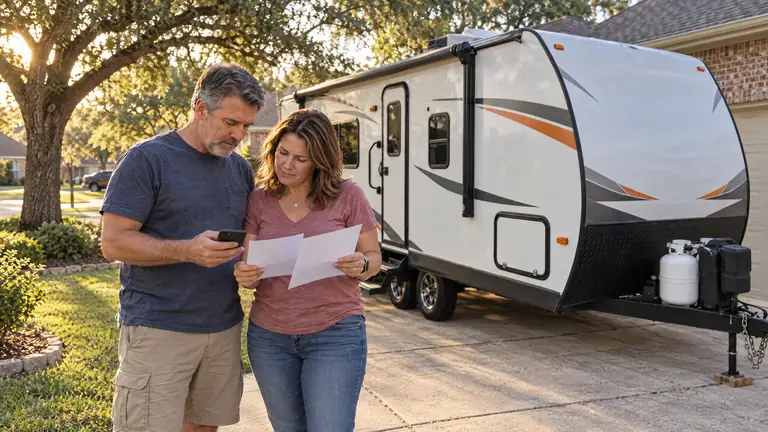
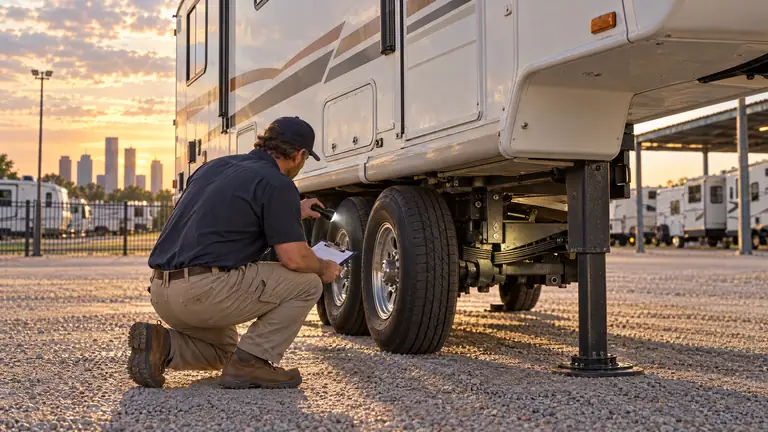
Before requesting a purchase offer, assemble the details below. Understanding what affects an RV cash offer helps explain why otherwise similar units may receive different amounts.
- Confirm the make, model, model year and floorplan.
- Gather maintenance invoices and roof or seal repair records.
- Record appliance operation and motorhome mileage.
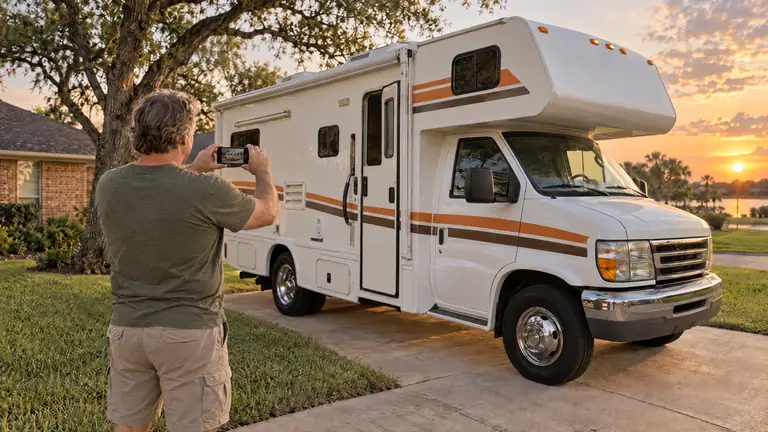
- Photograph the exterior, interior and known damage.
- Disclose leaks, musty odors, flood exposure and nonworking systems.
Selling your RV with a condition-based offer in Greater Houston
A condition-based purchase offer gives you a concrete selling option rather than another depreciation estimate. Cash For RV only buys RVs from owners in Greater Houston, including motorhomes and towables in clean, worn, damaged, flood-damaged or non-running condition; some units may not be a fit.
You can request an individual cash offer by sharing details and photos through our form, by phone or by text. We review the RV, often offer the same day, and arrange a quick in-person look wherever it is locally.
If the RV matches your description, the offer stands. Significant undisclosed issues may change it, with an explanation, and you can decline. At signing, we pay, handle title paperwork and any lender payoff, and tow or drive it away at no cost. There are no fees, commissions or obligation.
Frequently asked questions
Does RV mileage matter as much as car mileage?
Mileage matters for motorhomes, but it is only part of the valuation. Compare mileage alongside maintenance, chassis condition, operating systems and water damage. Low mileage does not guarantee good condition, especially if the RV sat neglected. Towables do not have an engine odometer to compare, but their roofs, tires, appliances and structure can still deteriorate while parked.
Are depreciation percentages based on MSRP or what I actually paid?
Check the publisher’s stated baseline before using a percentage. A decline from your actual purchase price is different from a discount from original MSRP. The J.D. Power historical estimates discussed here refer to purchase price where specified. For your own ownership calculation, compare what you actually paid with a supportable present value, rather than substituting an advertised original list price.
When should I sell my RV to get the best value?
There is no universal age that produces the best selling result. Consider current condition, local demand, upcoming maintenance and how long you expect to keep paying ownership costs. A generic depreciation curve cannot predict your best month or year. Our guide to the best time to sell an RV in Houston explains the practical timing factors to weigh.
How accurate are NADA or J.D. Power RV values?
They are useful starting points for model-specific pricing, not inspection-based offers. Select the correct model, equipment and mileage where applicable, then compare the result with current local listings and actual condition. A retail guide cannot fully account for an undisclosed leak, unusual renovation or buyer-specific acquisition costs. Keep Low Retail and Average Retail separate rather than treating either as guaranteed proceeds.
Why is my RV worth less than I expected?
Your expectation may be based on original MSRP, upgrade costs or high asking prices rather than comparable present-day value. Condition problems and weaker demand can also change the result. Your loan payoff does not determine market value: if it exceeds a purchase offer, you would need to cover the difference at closing. Confirm payoff requirements directly with your lender.
Does better diesel-pusher value retention make buying new a better choice?
Not necessarily. A reputation for stronger retention does not remove the initial new-to-used depreciation drop or establish your eventual proceeds. Compare the actual prices of closely matched new and used examples, their condition, equipment and maintenance needs. Dealer guidance about diesel retention is not a guarantee that a particular new diesel coach will cost less to own than a used alternative.
Sources
Related pages
 GuideHow much is my RV worth?Book values, comps, condition and what cash buyers pay.Read more
 GuideThe best time to sell an RV in HoustonSpring demand, summer heat, hurricane season and fall.Read more
 GuideShould I trade in my RV or sell it?Trade-in, private sale or cash offer, plus Texas tax.Read more
 GuideWhat affects an RV cash offer?The 12 factors that move a number up or down.Read more
 GuideHow long do RVs last?Lifespan by type, miles and major components.Read more
 SituationSell an old RV or camper in HoustonOlder motorhomes and campers dealers pass on.Read more
Ready when you are
Get a real number for your RV, not a listing estimate.
Send a few details and photos. We'll come back with a cash offer, and if it works for you, we handle the paperwork and the pickup.