Toy hauler vs. travel trailer: what's the difference?
Toy hauler vs travel trailer: garage and ramp, living space, weight, towing, cost and resale compared, plus tips for Houston owners selling either.
Published · By the Cash For RV team, Houston
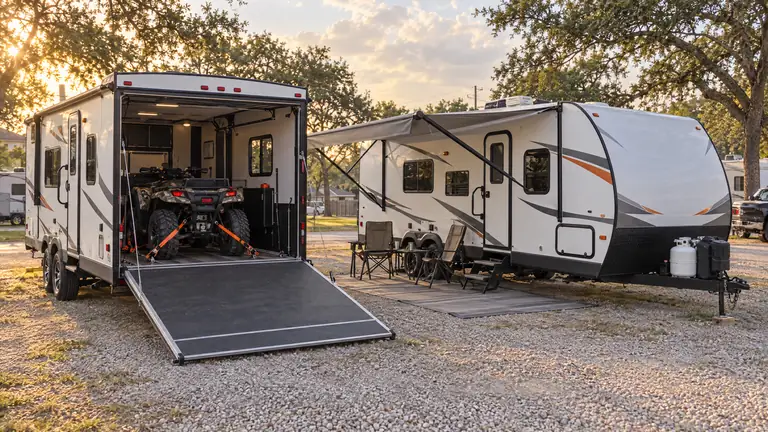
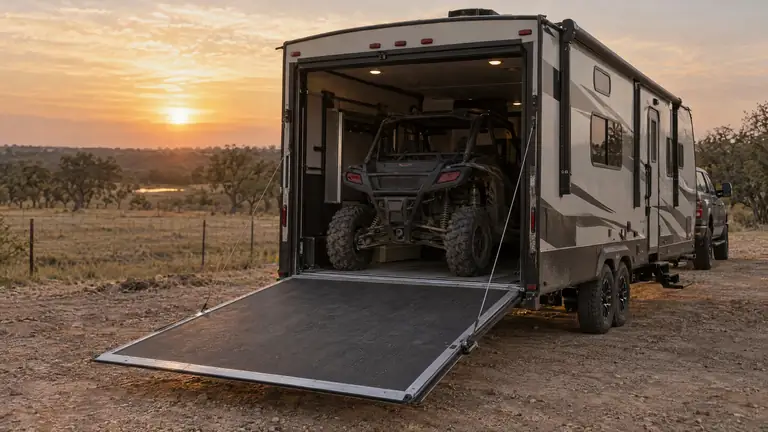
The main difference between a toy hauler and a conventional travel trailer is the rear garage and loading ramp. A toy hauler can itself be a travel trailer or a fifth wheel, so a toy hauler vs. travel trailer comparison is really about cargo space versus no purpose-built cargo space.
That garage can be valuable, but it takes room, adds equipment to maintain, and changes your loading calculations. The right choice depends on what you carry, how much permanent living space you need, and whether your tow vehicle can handle the actual loaded RV.
The short version
- A toy hauler describes a cargo-oriented layout, not a hitch type.
- Garage dimensions alone do not establish whether an RV can safely carry your equipment.
- Compare loaded weight, cargo capacity, axle ratings, and tow-vehicle payload rather than dry weight alone.
- Fuel stations, installed generators, and patio-capable ramps vary by model and equipment package.
- Neither category has a guaranteed resale advantage; condition and exact specifications matter more.
| Feature | Toy hauler | Travel trailer |
|---|---|---|
| Best fit | Regular equipment transport or a specific need for flexible garage space. | Permanent living space without an internal equipment garage or cargo-to-living conversion. |
| Rear garage | Rear ramp accesses a garage or shared cargo area; measure the actual opening and usable space. | Lacks the purpose-built rear loading ramp and motorized-equipment garage. |
| Living space | Garage may convert to sleeping, dining, or office space, but can reduce permanent residential rooms. | More of the same footprint can support permanent seating, kitchen space, bunks, or bedrooms. |
| Empty versus loaded weight | Often heavier for comparable living accommodations; compare individual unloaded weights and loaded ratings. | Often lighter without a garage, but large conventional trailers can outweigh small toy haulers. |
| Tow-vehicle fit | Check loaded weight, tongue or pin load, payload, combination ratings, and the appropriate hitch. | Ball-hitch towing still requires checking loaded weight, tongue load, payload, hitch, and combination ratings. |
| Cargo carrying capacity | Water, personal gear, and added equipment share the available capacity with transported equipment. | Finite capacity still applies; compare actual unit labels rather than assuming a category-wide disadvantage. |
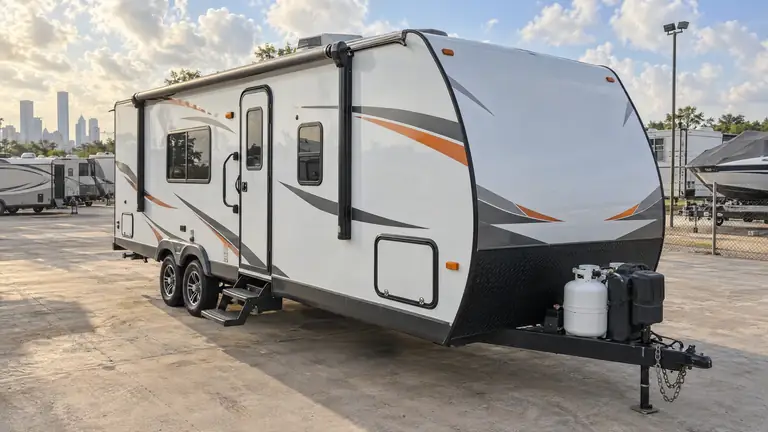
| Hitch types | Available as a ball-hitch travel trailer or a truck-bed-hitch fifth wheel. | Here, a conventional non-toy-hauler trailer with a ball hitch; travel trailers can also have toy-hauler layouts. |
| Purchase cost | Often costs more for similar living accommodations; no universal premium applies. | Often lower cost when no garage is needed; size, equipment, and condition can reverse individual comparisons. |
| Tie-downs | Verify anchor ratings, locations, condition, and the manufacturer's securement requirements. | Ordinary flooring, furniture, or storage areas do not establish a rated equipment-securement system. |
| Fuel station | Available on some models; standard versus optional equipment varies. | Not a defining feature; inspect the individual trailer's equipment. |
| Generator equipment | May have prep, an optional generator, or an installed generator; prep alone does not mean installation. | Compare actual power equipment and options rather than assuming an onboard generator is included or unavailable. |
| Cargo-oriented construction | Some documented models have heavy-duty chassis components; specifications vary. | Construction supports its own ratings and layout; lacking a garage does not automatically mean weaker construction. |
| Patio capability | Some ramps become patios with specified supports and equipment; not every ramp qualifies. | Does not have the toy-hauler rear-ramp patio arrangement. |
| Resale value | Exact model, condition, equipment, and comparable listings matter; higher original cost does not prove slower depreciation. | Use the same model-specific valuation process; no universal category-wide resale winner. |
Toy hauler vs. travel trailer: which labels actually overlap?
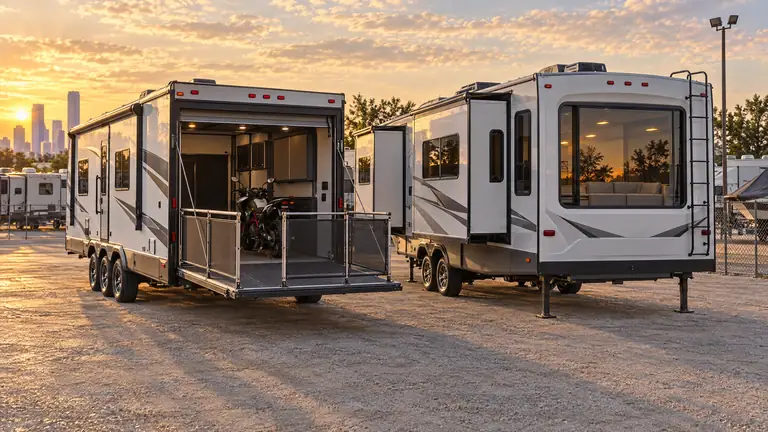
A toy hauler can be either a ball-hitch travel trailer or a truck-bed-hitch fifth wheel, while both hitch types also exist without garages. One RV dealer's guide describes these overlapping categories, which explains why comparing the labels alone can be confusing.
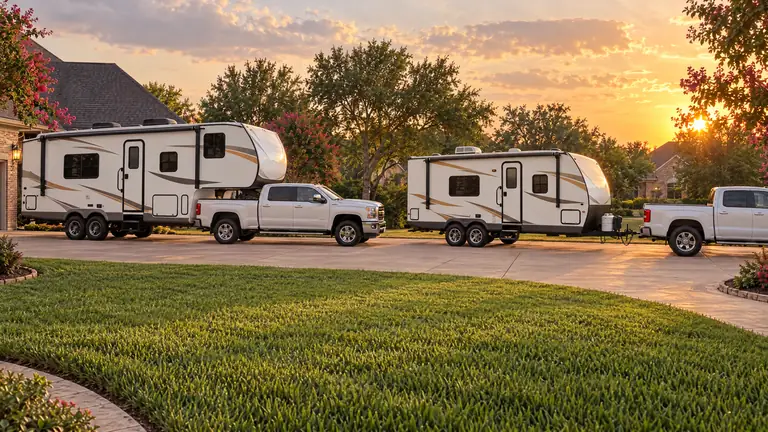
A toy hauler travel trailer connects through a ball and coupler. A fifth wheel toy hauler uses a kingpin and a fifth-wheel hitch in the truck bed; the garage does not determine that connection.
For this comparison, “travel trailer” means a conventional, non-toy-hauler travel trailer. Our guide to what makes an RV a toy hauler explains the layout distinction, while our fifth wheel versus travel trailer comparison addresses hitch-related differences.
Will your equipment fit in the garage?
Your equipment must clear the opening and interior obstacles while staying within the RV's loading and securement limits. Toy hauler garage size is only the beginning of that check.
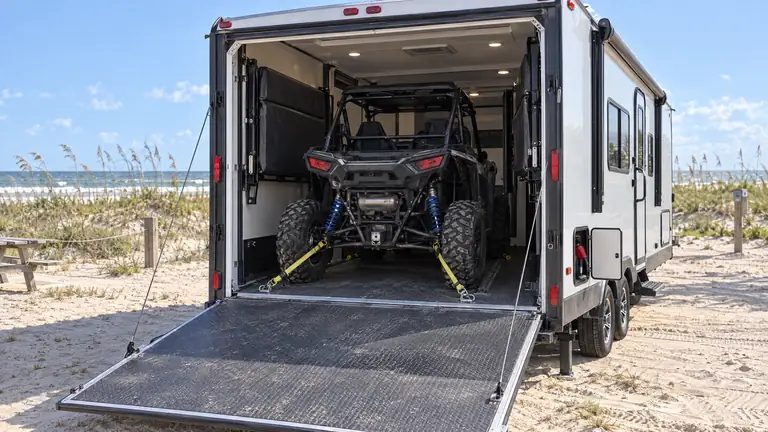
One RV dealer's guide describes garage lengths of roughly 8–18 feet, depending on the camper, not a guaranteed range for every model. Measure usable floor length, door width, entry height, overhead cabinets, and clearance around folding furniture.
Check the ramp's rating and approach angle as well as the garage floor and anchor requirements. Forest River's 2026 Work and Play equipment list specifies 1,500-pound-rated D-rings in its required Interior Value Package, but that model-specific anchor rating is not the garage's total capacity. Adding individual anchor ratings together does not establish a permissible vehicle weight.
Some ramps also become elevated patios. Confirm that the particular door supports that use and has the specified cables, railings, and accessories.
- Measure your equipment at its widest and tallest points.
- Check usable garage space with beds and furniture in their transport positions.
- Confirm ramp, floor, anchor, and securement requirements in the manufacturer's documentation.
How much living space do you give up?
A garage generally reduces permanent living space within a comparable overall footprint, although convertible furniture can make that area useful after unloading. A conventional trailer can devote the same space directly to seating, a kitchen, bunks, or bedrooms.
One RV comparison guide identifies this as a central trade-off: maintaining similar permanent living accommodations may require a larger toy hauler. A separate garage can preserve separation between cargo and living areas, while a shared cargo area may require more furniture rearrangement.
One RV dealer's guide documents garages used as dining rooms, sleeping areas, offices, and hobby rooms. Check how yours works with equipment aboard, not just when empty. Our toy hauler versus fifth wheel layout guide helps distinguish a need for flexible garage space from a preference for permanent rooms.
How much does a toy hauler weigh when loaded?
Toy hauler weight varies widely, and dry weight does not tell you what the trailer will weigh ready to travel. Toy haulers often weigh more than conventional trailers with similar living accommodations, but a small toy hauler can weigh less than a large conventional trailer.
Grand Design's current Momentum G-Class travel-trailer table lists unloaded weights of approximately 7,300–9,700 pounds and GVWRs of 11,000–13,000 pounds. Those are examples from one lineup, not category-wide limits, and they show why unloaded weight alone is insufficient.
Forest River defines GVWR as the maximum permissible fully loaded weight. It defines cargo carrying capacity, or CCC, as the allowance for fresh water, cargo, additional optional equipment, and accessories. Forest River's loading guidance uses approximately 8.3 pounds per gallon for fresh water, so advertised CCC is not exclusively available for your motorcycle or side-by-side.
Use the actual RV's labels. Forest River says its published specifications are estimated averages and that each shipped unit receives an actual unloaded-weight and cargo-capacity label. Grand Design's owner manual also directs owners to respect the cargo label, GVWR, and tire ratings, and identifies axle ratings on the certification label.
- UVW or unloaded weight describes the RV before your travel load.
- GVWR limits the fully loaded RV.
- CCC must cover water, personal gear, equipment, and added accessories.
- Axle, tire, ramp, and securement limits still apply independently.
Can your truck handle the hitch load and Texas requirements?
Your tow vehicle must accommodate both the loaded trailer and the load the trailer places on the vehicle. An advertised tow rating or truck badge is not a complete compatibility check.
For a travel trailer, assess loaded tongue weight against the tow vehicle's payload and applicable hitch ratings. For a fifth wheel, assess loaded pin weight and the truck-bed hitch requirements. Passengers, gear, and hitch equipment also use truck payload.
Cargo placement changes weight distribution, so adding equipment to a rear garage does not always increase tongue or pin weight. Follow the loading instructions and verify loaded weights rather than treating published unloaded hitch weight as travel-ready weight.
Texas DPS lists noncommercial Class A authorization for combinations with GCWR of 26,001 pounds or more when the towed vehicle or vehicles have GVWR exceeding 10,000 pounds. A heavy trailer alone does not establish that threshold. Texas DPS also distinguishes the personal-use RV exemption from CDL requirements from the possible need for an appropriate noncommercial Class A or B license; confirm your combination with DPS.
Are fuel stations and generators included?
Fuel stations and generators are model-specific equipment, and generator prep does not mean a generator is installed. Check the actual RV and its equipment documentation rather than assuming these features come with every toy hauler.
Forest River's 2026 Work and Play list makes that distinction explicit: a 30-gallon fuel station is standard on the high-profile 27KB, 29SS, and 30GS, but optional on LT models. An integrated station can be useful for gasoline-powered equipment, but it is not what defines a toy hauler.
Forest River separately lists Generator Prep as standard on its high-profile models and an Onan generator as optional. Toy hauler generator prep should prompt questions about what is present and what installation still requires, not an assumption that the package is complete.
The same approach applies to construction. Forest River documents heavy-duty chassis components on Work and Play models, but that does not prove every toy hauler has a stronger frame than every conventional trailer.
Are toy haulers worth the extra cost and storage space?
A toy hauler is worth considering when its garage solves a recurring transportation or space need; a conventional trailer usually makes more sense when permanent living space matters more. These are the central toy hauler pros and cons, rather than a universal winner.
One RV comparison guide says conventional trailers generally cost less than toy haulers offering comparable living accommodations. Size, equipment, brand, age, and condition can reverse an individual comparison. Grand Design also explains that MSRP excludes items such as freight, tax, title, license, and dealer preparation, so compare prices on the same basis.
For storage, measure the actual RV against your parking space, gate, and access route. If preserving your preferred living space requires a larger toy hauler, that larger unit must fit where you keep it.
Choose a toy hauler for regular equipment transport or a clearly useful flexible room. Choose a conventional trailer when you want permanent furniture, fewer cargo-to-living conversions, and no internal equipment garage.
What matters for resale in Greater Houston?
Neither toy haulers nor conventional travel trailers have a guaranteed resale advantage in Greater Houston. Value the exact year, make, model, floor plan, equipment, and condition rather than assuming the garage creates a premium.
One RV marketplace's valuation guide emphasizes age, maintenance documentation, water damage, roof condition, tire age, and installed equipment. Comparable asking prices are not completed-sale prices, and retail guide values are not guaranteed direct-purchase offers. Our guide to estimating your RV's value explains these distinctions.
For a toy hauler, photograph the ramp and seals, garage floor, anchor points, capacity labels, and any generator or fuel station. Describe generator prep separately from an installed generator. For either type, disclose leaks, damage, and modifications without assuming upgrades will recover their full cost.
Selling either RV type to Cash For RV
We buy both toy haulers and conventional travel trailers from owners in Greater Houston, including clean, worn, damaged, flood-damaged, and end-of-life units. Some RVs may not be a fit, and we say so honestly.
We review overall condition, roof and water damage, equipment, and your description; a toy hauler's ramp and garage condition also matter. See our pages for selling your toy hauler in Houston or selling your travel trailer in Houston, then request a cash purchase offer. We review details and photos, make an offer, and arrange an in-person look, with no fees or obligation.
At signing, we pay, handle title paperwork and any lender payoff, and remove the RV at no cost. TxDMV recommends filing a Vehicle Transfer Notification within 30 days; confirm applicable signed-title and transfer-document requirements with your county tax office.
Frequently asked questions
Is a toy hauler worth it if I carry a motorcycle on only one trip each year?
It may be, but occasional transport alone may not justify the living-space trade-off and ownership cost. Consider whether the garage serves another useful purpose during the rest of your ownership. Compare actual trailers, including loaded towing requirements and storage fit, rather than assuming every toy hauler carries the same weight penalty.
Can I put a motorcycle carrier on the back of a regular travel trailer instead?
Do not assume a rear bumper or receiver can carry a motorcycle. Confirm the trailer manufacturer's permitted use, attachment ratings, carrier limits, and loading requirements before considering that arrangement. A rear-mounted load can also change trailer balance. Having enough overall cargo capacity does not establish that a particular rear attachment is suitable.
Which small toy hauler can I tow with a Denali 1500?
The model name alone cannot determine a suitable trailer. Check your specific truck's configuration, payload label, towing and combination ratings, and hitch limits. Then compare the intended toy hauler's loaded weight and tongue load, allowing for passengers, truck cargo, and hitch equipment. Confirm compatibility using both manufacturers' documentation, not dry weight alone.
Can I furnish a toy hauler garage myself for full-time use?
Some garages can function as offices, bedrooms, or other living areas, but suitability depends on the floor plan and equipment. Check furniture securement, exit access, manufacturer instructions, and the weight of additions. If you still transport equipment, make sure the furnishings do not obstruct required clearances or interfere with the approved securement arrangement.
How much does insulation matter in a toy hauler?
For extended occupancy, evaluate the actual model's insulation, heating and cooling equipment, and garage separation rather than relying on the toy-hauler label. Houston's hot, humid summers make those details worth checking. An advertised insulation package does not establish that every part of the RV performs identically or that it is protected against flooding.
Can a toy hauler carry a small car?
Some configurations may be suitable, but fitting inside is not enough. One RV dealer's guide identifies garage space, cargo capacity, tie-down ratings, and ramp angle as considerations. Check the car's actual loaded weight and dimensions against the RV's ramp, floor, securement, axle, tire, and overall ratings, then confirm the intended use with the manufacturer.
Sources
- TxDMV: Buying or selling a vehicle
- Texas DPS: Classes of driver licenses
- Forest River: Work and Play specifications and equipment
- Grand Design: Momentum G-Class travel trailers
- Grand Design: Imagine travel trailer owner manual
- Grand Design: Momentum G-Class 25G pricing disclosure
- Camping World: Advantages of owning a toy hauler
- Camper Report: Travel trailer versus toy hauler
- RVshare: Understanding RV values
Related pages
 GuideWhat is a toy hauler?Garages, ramps and the three kinds of toy hauler.Read more
 GuideToy hauler vs. fifth wheel: garage or more living space?Garage space vs living space in a fifth wheel.Read more
 GuideFifth wheel vs. travel trailer: which is right for you?Hitch, tow vehicle, space and storage compared.Read more
 RV typeSell your toy hauler in HoustonGarage-model trailers and fifth wheels.Read more
 RV typeSell your travel trailer in Houston for cashBumper-pull campers of any length, age or condition.Read more
 GuideHow much is my RV worth?Book values, comps, condition and what cash buyers pay.Read more
Ready when you are
Get a real number for your RV, not a listing estimate.
Send a few details and photos. We'll come back with a cash offer, and if it works for you, we handle the paperwork and the pickup.