Pop-up vs. hybrid vs. travel trailer: comparing all three
Pop-up camper vs hybrid vs hard-sided travel trailer: weight, setup, Texas heat and humidity, canvas care, storage and resale compared for Houston owners.
Published · By the Cash For RV team, Houston
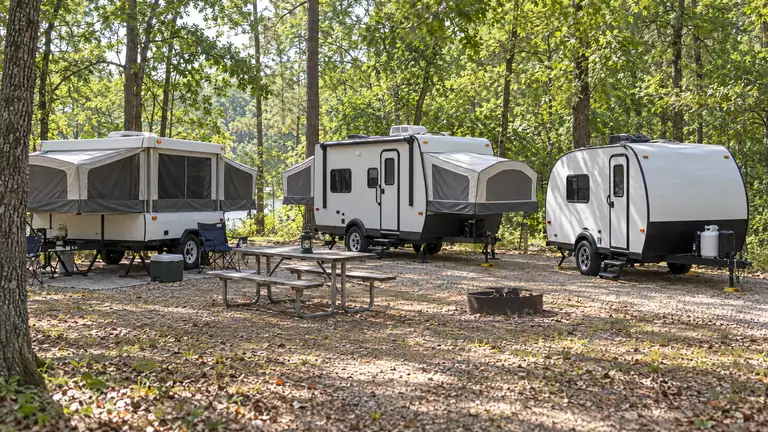
When comparing a pop-up vs. hybrid vs. travel trailer, choose a tent pop-up for compact storage, a hybrid for expandable beds around a solid living area, or a hard-sided travel trailer to avoid tent-bed deployment and drying. The best fit depends on your loaded towing limits, storage space and willingness to maintain fabric, not a fixed weight or price ranking.
For Houston owners, heat, humidity and somewhere to reopen wet tenting deserve particular attention. Here, “pop-up” means a soft-sided tent camper, not a hard-sided folding A-frame, and “hybrid” means an expandable travel trailer with fold-out tent beds.
The short version
- Compare loaded weights and hitch loads because camper categories overlap in weight.
- Pop-ups fold lower for storage, while folding a hybrid’s beds does not lower its main roof.
- Both tent pop-ups and hybrids need complete fabric drying before storage.
- Air conditioning can be available on all three types, but tent sections remain less insulated.
- Condition and the exact model matter more than an assumed category-wide resale advantage.
| Feature | Tent pop-up | Hybrid | Hard-sided travel trailer |
|---|---|---|---|
| Loaded towing checks | Potentially lower weight, but verify loaded weight, hitch load, vehicle payload and all applicable ratings. | Tent beds do not establish SUV compatibility; verify loaded weight, hitch load and all applicable ratings. | Small models may weigh less than hybrids; use the same loaded-weight and hitch-load checks. |
| Published empty-weight examples | Forest River’s 2027 Rockwood Tent examples: approximately 1,300–2,500 pounds UVW, not an industry-wide range. | Forest River’s 2027 Roo examples: 233S at 4,976 pounds UVW; 235S at 5,478 pounds UVW. | Forest River’s 2027 Geo Pro examples: approximately 1,800–4,200 pounds UVW; not an equivalent-capacity comparison. |
| Construction and folding | Roof lifts; soft-sided enclosure and beds deploy. A rigid roof is possible. | Rigid main body stays full height; tent-bed ends fold outward. | Hard-sided enclosure needs no tent-bed deployment; some floorplans have slideouts. |
| Garage storage | Forest River’s 2027 1640FT: 5 feet closed height, 84 inches width, 11 feet 10 inches closed length. Measure actual clearances. | Forest River’s 2027 Roo 233S: 10 feet 6 inches exterior height. Folding beds does not lower its roof. | Measure full equipped height, width and length; a small floorplan does not guarantee garage fit. |
| Setup effort | One RV dealer estimates approximately 10–30 minutes, depending on familiarity; not a complete site-setup benchmark. | One RV dealer describes tent-end deployment as taking minutes; other setup tasks remain. | No tent-bed deployment, but leveling, stabilization, hookups and any slideouts remain. |
| Wet pack-up work | Reopen wet tenting promptly and dry completely before storage. | Tent ends require the same reopening and complete drying. | No tent ends to refold; wet interiors and water intrusion still need attention. |
| Heat and insulation | Fabric enclosure provides less insulation than hard sides; available air conditioning does not guarantee summer comfort. | Solid living body, but tent sleeping ends remain less insulated. | Avoids tent sections; construction and cooling equipment still determine performance. |
| Air-conditioning availability | Forest River’s current Rockwood Freedom package lists 15,000-BTU under-bunk air conditioning; check the actual unit. | Forest River’s current Roo features list 15,000-BTU air conditioning and an optional dual-unit configuration. | Equipment varies by floorplan and package; capacity is not a head-to-head cooling result. |
| Sleeping and living space | Expandable beds add usable space beyond the closed footprint. | Tent beds can preserve central living space; compare actual bed dimensions. | Beds occupy interior space or use conversions, bunk layouts or slideouts. |
| Moisture and maintenance | Inspect tenting, roof and lift operation; mildew-resistant fabric still needs drying. | Inspect tenting, latches, bunk platforms and moisture history. | Inspect roof penetrations, seals and interior moisture; hard sides are not leak-proof. |
| Cost and resale | Often a lower-cost entry; condition, lift operation and fabric can change ownership costs. | Compare exact models and condition; no universal price or resale advantage. | Compare exact models and condition; no established category-wide depreciation winner. |
| Best practical fit | Owners prioritizing compact storage and lower-weight possibilities who accept deployment and drying work. | Owners wanting expandable beds and a solid living body who accept tent-end care. | Owners prioritizing no tent-bed deployment and less fabric maintenance, within towing and storage limits. |
Pop-up vs. hybrid vs. travel trailer: what actually folds?
A tent pop-up collapses its living enclosure, a hybrid folds its tent beds, and a conventional travel trailer keeps its hard-sided enclosure intact. These differences affect access, storage and maintenance throughout ownership.
On a traditional tent pop-up, the roof lifts and the fabric walls and sleeping sections deploy. That does not mean the roof itself is canvas. Forest River’s current Rockwood Freedom examples have a rigid fiberglass-laminated roof, with soft-sided sections beneath it.
A hybrid retains a full-height, hard-sided main body containing its central living area. Its bed ends fold outward and receive tent enclosures. A hard-sided travel trailer needs no tent-bed deployment, although some floorplans have slideouts that require clearance and setup.
Check access with everything closed. Depending on the floorplan, you may need to raise a pop-up or move a slide before reaching appliances, cabinets or other interior areas.
What vehicle do you need to tow each camper?
You need a tow vehicle that can handle the camper’s loaded weight and hitch load within all applicable ratings, regardless of camper type. An advertised dry weight below your tow rating is not enough.
Forest River’s populated 2027 Rockwood Tent listings show approximately 1,300–2,500 pounds UVW, while its 2027 Roo hybrids list 4,976 pounds UVW for the 233S and 5,478 pounds for the 235S. These are representative published examples, not industry-wide ranges or loaded scale weights.
Hard-sided does not automatically mean heavier. Forest River’s 2027 Geo Pro examples span approximately 1,800–4,200 pounds UVW, below those Roo examples. This is not a comparison of equivalent size or sleeping capacity.
Forest River defines UVW as typical factory weight including LP gas but excluding cargo, fresh water, additional optional equipment and dealer-installed accessories. GVWR is the maximum permissible fully loaded trailer weight. Use the actual unit’s weight and cargo-capacity labels, then follow Jayco’s guidance to weigh the loaded RV and tow combination.
An SUV may suit a particular camper, but its available payload must accommodate hitch load along with passengers and vehicle cargo. Texas DPS also notes that personal RV use can still require a noncommercial Class A or B license; confirm your combination’s ratings and applicable requirements with DPS.
- Check loaded trailer weight against trailer GVWR and the vehicle’s towing limits.
- Account for hitch load, passengers and cargo within the tow vehicle’s ratings.
- Verify the hitch, vehicle and combination ratings rather than relying on camper category.
How long does a pop-up or hybrid take to set up?
A pop-up usually involves more enclosure deployment than a hybrid, while a hard-sided trailer eliminates tent-bed setup. Total effort still depends on the model, site and your familiarity with the equipment.
One RV dealer’s guide estimates typical pop-up setup at approximately 10–30 minutes, depending on experience. Treat that as a rough estimate, not a timed comparison covering every leveling, stabilization and hookup task.
Another dealer’s expandable-trailer guide describes deploying hybrid tent ends as taking a matter of minutes. You still need to secure the beds and fabric correctly, and any slideouts add their own tasks. A hard-sided trailer still needs positioning, leveling, stabilization and applicable hookups.
The overlooked difference is packing up after rain. Pop-ups and hybrids may require another deployment at home to dry the tenting completely. If your driveway or storage arrangement cannot accommodate that, the drying work may matter more than the initial setup time.
Which camper gives you more beds and better garage fit?
Pop-ups offer the strongest potential for low-clearance storage, while hybrids can place multiple beds outside a full-height living body. Neither advantage guarantees a fit for your garage or sleeping needs.
Forest River lists its 2027 Rockwood Tent 1640FT at 5 feet high, 84 inches wide and 11 feet 10 inches long when closed, expanding to 17 feet 2 inches long when open. Measure the equipped camper, garage opening and interior clearance, including room to maneuver.
Folding hybrid beds does not lower the roof. Forest River lists the 2027 Roo 233S at 10 feet 6 inches exterior height, so an opening below that height cannot accommodate that example.
For sleeping space, Forest River’s Roo 233S lists three expandable queen beds measuring 60 by 80 inches, plus convertible dinette and sofa positions. That illustrates how a hybrid separates beds from the main living footprint, but advertised sleeping capacity is not a promise of adult comfort. Compare usable bed dimensions and what remains accessible when conversions are occupied.
Can pop-ups and hybrids stay cool in Texas heat?
Pop-ups and hybrids can have air conditioning, but their tent sections provide less insulation than hard-sided enclosures. Cooling equipment alone does not guarantee a particular indoor temperature in Houston summer sun.
Forest River’s current Rockwood Freedom convenience package lists a 15,000-BTU under-bunk air conditioner, but that equipment is not listed across every tent-camper series. Its current Roo features also list 15,000-BTU air conditioning, showing that tent-end hybrids can have substantial cooling equipment.
Hard-sided models vary too. Forest River’s current Geo Pro specifications list different cooling configurations by floorplan and package. Compare the actual installed equipment and enclosure construction rather than assuming every hard-sided trailer performs alike.
Shade and clean air-conditioning filters can help reduce cooling challenges, according to one RV dealer’s hybrid guide. Jayco warns that running air conditioning without its return-air filter can reduce airflow and damage equipment. A hard-sided trailer removes tent sleeping sections, but roof seals and air-conditioning gaskets still require attention.
Will hybrid camper canvas get mildew or condensation?
Hybrid and pop-up tenting can develop mildew if stored damp, and interior condensation must be distinguished from rain entering through a leak. Mildew-resistant fabric is not mildew-proof.
Jayco’s tent-equipped Jay Feather manual says to reopen wet-packed tenting and dry it thoroughly as soon as possible. The entire tent must be completely dry before storage, and its canvas portion takes longer to dry than vinyl. Jayco explicitly says ventilation and drying are even more important in humid climates.
For Houston ownership, plan where you can reopen the camper after returning home. A covered storage space that fits the closed unit may not provide enough room to deploy its beds and dry the fabric.
Moisture inside a tent roof is not, by itself, proof of a leaking seam. Investigate when and where dampness appears, including beneath mattresses, rather than dismissing all moisture as condensation or calling every droplet a leak.
Follow the exact material-care instructions. Jayco specifies a soft cloth or sponge, not a brush, for cleaning the exterior vinyl side described in its manual. Cleaning, seasoning and seam treatment are model-specific, so a universal bleach or waterproofing-spray recommendation is inappropriate.
Who does each camper type suit best?
A pop-up suits storage-first owners, a hybrid suits owners prioritizing expandable beds, and a hard-sided trailer suits those wanting less tent-fabric work. The right individual unit still has to fit your towing and storage constraints.
A tent pop-up is practical if low closed height and potentially lower weight outweigh roof-lifting, bed deployment and drying work. Confirm that you can physically operate its mechanisms and have space to open it when needed.
A hybrid is worth considering when you want multiple dedicated beds without placing all of them inside the central floorplan. The tradeoff is a full-height trailer plus tent-end inspection and drying obligations.
A hard-sided trailer is the stronger fit if avoiding fabric-bed deployment is your priority. You still need to inspect seals, manage interior moisture and compare actual weight, dimensions and cooling equipment.
What should you budget for ownership and eventual resale?
Budget around the exact camper’s condition, storage and maintenance needs rather than assuming one category is always cheapest or retains value best. Tent pop-ups are often a lower-cost entry point, but damaged fabric or a faulty lift can change that calculation.
Hybrids combine conventional trailer components with tent ends, bunk platforms and latches. Hard-sided trailers avoid tent-fabric replacement but still have roof penetrations, seals and other wear items. There is no dependable universal canvas-replacement interval or category-wide lifespan ranking.
J.D. Power provides model-specific pricing and used values as a starting point. A guide value, an advertised retail asking price and an inspected buyer’s cash offer are different measures. Our guide to estimating your RV’s value explains how condition fits into that distinction.
Before an eventual sale, keep service and fabric-replacement receipts and photograph deployed tent sections, seams, stains and prior repairs. Review these RV water-damage warning signs, and disclose active leaks, soft areas, mildew and wet-storage history. Removing visible mildew does not establish that underlying materials are sound.
Selling a pop-up, hybrid or travel trailer in Greater Houston
We buy all three camper types in Greater Houston, including worn, damaged, flood-damaged and end-of-life units, although some may not be a fit. For selling your pop-up camper, document roof-lift operation and tenting; for hybrids, show tent ends, latches, bunk platforms and moisture history. When selling your travel trailer, document roof, seal and interior condition.
Send details and photos through our form, by phone or by text to request a cash offer. We review them, often offer the same day, and arrange a quick in-person look wherever the RV is in Greater Houston.
If its condition matches your description, the offer stands; significant undisclosed issues may change it, with an explanation and no obligation. At signing, we pay, handle title paperwork and any lender payoff, then remove the RV at no cost. See how our buying process works.
Frequently asked questions
Is leakage at a hybrid’s canvas seams normal?
Do not ignore recurring seam leakage. Jayco’s tent-equipped manual describes a new-tent seasoning procedure and seam sealing if seepage remains, but that is not a universal instruction for every camper. Confirm whether moisture is entering from outside, inspect the affected area and follow your model’s manual. Persistent water entry needs attention before it damages surrounding materials.
Why is there moisture between a bunk mattress and its platform?
Condensation is a possible cause, but mattress dampness alone does not establish where the moisture originated. Inspect the mattress underside, platform, nearby tenting and seams, and note whether the problem follows rain or occurs without it. Dry affected materials completely and follow your manufacturer’s ventilation guidance. Recurring moisture or soft areas warrant further inspection rather than simply covering the platform.
Will ventilation stop condensation when the furnace is running?
Ventilation can reduce moisture accumulation, but it does not guarantee that condensation will disappear. Jayco advises leaving a small opening at each bunk zipper on its tent-equipped models to allow airflow and minimize moisture above the bunks. Follow your own manual, keep damp materials from remaining enclosed and investigate persistent wetness. A heated interior does not make tenting immune to condensation.
Does lightweight mean a hybrid will work with my SUV?
No. “Lightweight” is not a towing approval, and published empty weight excludes important loads. Check the actual camper’s labels, expected loaded weight and hitch load against your SUV’s ratings, accounting for passengers and cargo. Jayco recommends weighing the loaded RV and tow combination. Confirm the match using the vehicle and trailer manuals rather than a marketing description.
Can I leave my pop-up folded after bringing it home wet?
Jayco instructs owners of its tent-equipped models to reopen wet tenting and dry it thoroughly as soon as possible, with complete drying before storage. There is no fixed safe wet-storage interval to rely on. Arrange a place where you can deploy the camper after returning home, and check all fabric rather than assuming a dry vinyl surface means everything is dry.
Sources
- Forest River: Rockwood Tent specifications
- Forest River: Rockwood Roo specifications
- Forest River: Rockwood Geo Pro specifications
- Forest River: Rockwood Tent 1640FT dimensions
- Jayco: Jay Feather owner’s manual
- Texas DPS: Classes of driver licenses
- J.D. Power: RV pricing and values
- Camping World: Pop-up camper guide
- Campers Inn: Expandable travel trailers
- Camping World: Hybrid camper guide
Related pages
 GuideFifth wheel vs. travel trailer: which is right for you?Hitch, tow vehicle, space and storage compared.Read more
 GuideMotorhome vs. travel trailer: comparing the full pictureDrivable vs towable: cost, convenience and upkeep.Read more
 RV typeSell your pop-up camper in HoustonTent campers, A-frames and hybrids.Read more
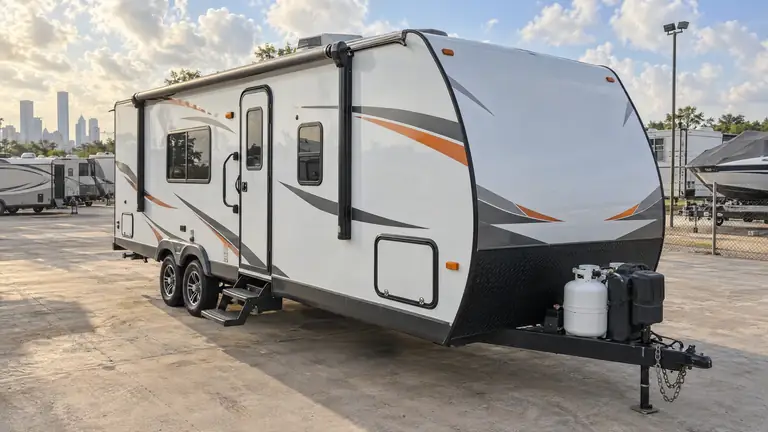 RV typeSell your travel trailer in Houston for cashBumper-pull campers of any length, age or condition.Read more
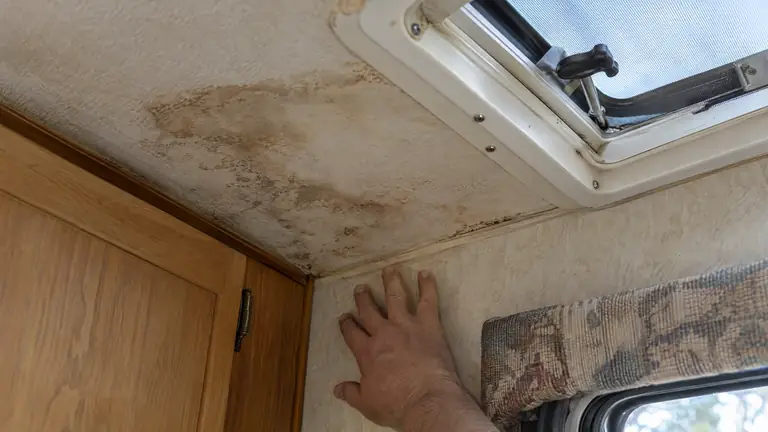 GuideSigns of RV water damage, and what they mean when you sellWhere to look, how to test, and what it means for value.Read more
 GuideHow much is my RV worth?Book values, comps, condition and what cash buyers pay.Read more
Ready when you are
Get a real number for your RV, not a listing estimate.
Send a few details and photos. We'll come back with a cash offer, and if it works for you, we handle the paperwork and the pickup.