Diesel pusher vs. gas motorhome: how they really compare
Diesel pusher vs gas Class A: engine placement, chassis, ride, noise, towing, upkeep and resale compared. Selling either in Houston? We buy both.
Published · By the Cash For RV team, Houston
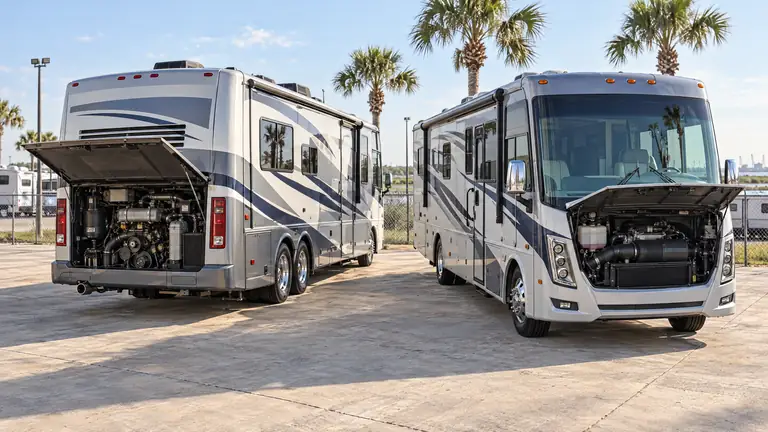
In a diesel pusher vs. gas motorhome comparison, the diesel usually offers a quieter front cab, air-suspension comfort and greater towing potential, while the gas Class A generally costs less to buy and service. Neither is automatically the better choice: the finished coach’s ratings, condition, equipment and maintenance history matter more than fuel type alone.
A diesel pusher specifically has a rear-mounted engine; not every diesel motorhome is a pusher. Compare actual coaches rather than assuming that moving from gasoline to diesel guarantees better interior quality, lower fuel costs or easier driving.
The short version
- Diesel pushers generally offer quieter front-cab driving and air suspension, but equipment varies by chassis.
- Gas Class A coaches usually have lower purchase and basic service costs, and Ford Tow/Haul provides downhill engine braking.
- Towing ability depends on the finished motorhome’s weight ratings and loaded weight, not just the hitch label.
- Texas licensing follows vehicle and combination ratings, not diesel versus gasoline or the presence of air brakes.
- Maintenance records, storage history and house-system condition matter to resale alongside engine type and mileage.
| Feature | Diesel pusher | Gas Class A |
|---|---|---|
| Purchase price | Generally higher initial cost; chassis, equipment and luxury level also influence the difference. | Generally lower entry cost; higher-end gas models can overlap lower-tier diesels in quality. |
| Maintenance expense | Basic engine service generally costs more; filtration, emissions equipment and chassis systems add maintenance obligations. | Basic engine service generally costs less; confirm that the service shop can accommodate the completed motorhome. |
| Suspension and ride | Air suspension is common; independent front suspension and tag axles depend on the particular chassis. | Standard Ford F-53 uses leaf springs; suspension modifications can change ride quality. |
| Cab noise and heat | Rear engine generally reduces engine noise at the driver’s position; heat and noise remain elsewhere. | Front engine is nearer occupants; insulation, engine generation and driving load affect perceived noise and heat. |
| Towing capability | Often higher ratings, but finished-coach limits and loaded combined weight determine usable capacity. | Often lower ratings, but no universal gas towing ceiling applies; verify the finished coach. |
| Texas driver licensing | Texas DPS bases license class on vehicle and combination ratings; personal-use CDL exemption does not waive noncommercial requirements. | The same Texas DPS rating rules apply; gasoline does not automatically mean Class C privileges are sufficient. |
| Fuel economy | Potential efficiency advantage in comparable applications; published estimates overlap gas results. | Actual mileage varies with the coach and operation; do not assume diesel fuel savings repay its purchase premium. |
| Service brakes | Air brakes are common; their presence does not establish shorter stopping distance. | Hydraulic service brakes are conventional; performance depends on the complete vehicle and its condition. |
| Downhill braking assistance | Exhaust or engine braking depends on engine equipment and operating instructions. | Ford Tow/Haul provides engine braking and transmission downshifts to help control descent speed. |
| Engine placement | Rear-mounted diesel engine, away from the driver; not a description of every diesel motorhome. | Conventional front-mounted gasoline engine near the cab. |
| Chassis and powertrain | Common suppliers include Freightliner and Spartan; engine, transmission and axle specifications vary by model. | Contemporary coaches usually use Ford F-53; older used coaches can have different chassis and powertrains. |
| Engine longevity | Potential longevity advantage does not guarantee an individual engine’s life or preserve aging house systems. | Maintenance, storage and house-system condition matter alongside mileage and potential remaining engine life. |
| DEF requirements | SCR-equipped diesels require DEF; confirm engine build and emissions equipment rather than relying only on coach year. | Gasoline engines do not use diesel DEF systems, but have their own emissions equipment. |
| Resale and depreciation | Newmar describes stronger value retention as a tendency, not a guaranteed premium or smaller dollar loss. | Lower initial cost commits fewer dollars upfront; condition and demand prevent a universal gas depreciation rule. |
Diesel pusher vs. gas motorhome: what changes behind the wheel?
The biggest driving differences come from engine location and chassis design, not simply the fuel in the tank. A rear-engine diesel pusher generally puts less engine noise at the driver’s seat than a conventional front-engine gasoline Class A, according to an RV industry publication.
Engine heat is also farther behind the cab in a pusher, but it has not disappeared. In a gas coach, front-cab noise and perceived heat depend on insulation, engine generation and driving load; the entire diesel coach is not necessarily quieter in every location.
Freightliner and Spartan are notable diesel-pusher chassis suppliers. An RV industry publication describes contemporary Ford F-53 gasoline chassis as using a 7.3-liter V8 and six-speed automatic, but older used coaches may have a V10 or another configuration.
Standard F-53 suspension uses leaf springs, while air suspension is common on pushers. Freightliner identifies Air Ride as standard on its diesel offering, but independent front suspension and steerable tag axles are not universal. Test-drive the actual coach, including any suspension modifications, and use our Class A versus Class C comparison if you are also reconsidering motorhome size.
Does a diesel pusher brake better on hills?
A diesel pusher may offer useful exhaust or engine braking, but air brakes alone do not prove it stops sooner than a gas coach. Air service brakes are common on pushers; conventional gasoline Class A coaches generally use hydraulic service brakes.
Cummins describes a variable-geometry-turbo exhaust brake for its B6.7 motorhome engine and instructs drivers to switch it off on slippery roads. Equipment and instructions are engine-specific, so learn the controls and warnings for your particular coach.
Gas motorhomes also have downhill braking assistance. Ford’s motorhome chassis manual says Tow/Haul provides engine braking in all forward gears and can downshift to help control descent speed. Compare the complete vehicle and its condition rather than treating either braking system as permission to descend faster.
Does towing make diesel the better choice?
Diesel pushers often have higher towing ratings, but the finished coach’s limits determine whether it can safely accommodate your load. One RV dealer’s Winnebago comparison uses 5,000-pound gas and 10,000-pound diesel examples; those are lineup examples, not universal Class A limits.
Ford defines GCWR as the maximum allowable combined weight of the vehicle and loaded trailer, including passengers and cargo. Its manual also prohibits exceeding GVWR or axle ratings, so a chassis brochure or hitch label does not establish your usable towing allowance.
Check the motorhome manufacturer’s towing instructions and compare them with actual loaded weights. A dinghy or trailer can change which coach makes sense even when the floorplans are similar. For another heavy-hauler comparison, see Super C versus Class A diesel pusher.
- Confirm the finished coach’s GVWR, GCWR, axle ratings and hitch limits.
- Account for passengers, cargo and the actual loaded towed vehicle.
- Check braking and towing-equipment requirements in the applicable manuals.
What should you budget for fuel and maintenance?
Gas coaches generally cost less for basic engine service, while diesel’s potential fuel-economy advantage does not guarantee lower total operating costs. Fuel prices change, and chassis systems, emissions equipment and service requirements also affect ownership expense.
An RV industry publication estimates roughly 6–10 mpg for gasoline Class A coaches and 8–14 mpg for similarly sized diesels. These are editorial estimates, not controlled tests; one RV dealer’s guide instead suggests approximately 7–10 mpg for either type. The overlap makes a guaranteed diesel fuel-saving claim unreliable.
Diesel pusher maintenance costs are generally higher for basic engine service because diesels commonly use larger oil quantities and additional fuel filtration or water-separation components. Gas service locations may be easier to find, according to one dealer’s guide, but confirm that a shop can physically accommodate your completed motorhome.
Low annual mileage does not cancel scheduled service. Cummins specifies elapsed-time or mileage intervals, whichever comes first, and directs owners to engine-serial-number-specific guidance. Ask for the applicable schedule rather than accepting a universal annual maintenance estimate.
DEF is another model-specific responsibility. Cummins says covered B-series engines built since 2010 require it; verify engine build information rather than relying only on coach model year. Freightliner explains that DEF enters the exhaust stream, not the diesel tank, and warns that low DEF can reduce engine power.
For Houston-area storage, follow the temperature limits rather than assuming a hot compartment is suitable. Cummins specifies sealed-container storage below 78°F for its stated maximum DEF shelf life of 18 months. That guidance does not establish the same shelf life under hotter storage conditions.
Does diesel motorhome engine life outweigh coach age?
Potential diesel engine longevity is useful, but it does not make an aging motorhome’s roof, appliances, wiring or plumbing last longer. An RV industry publication emphasizes that coach build quality, maintenance and storage heavily influence overall useful life.
Treat broad engine-life estimates as expectations, not a warranty on a used coach. An engine with substantial theoretical life remaining can still need attention, while house systems may age out before the drivetrain.
Mileage alone cannot tell you whether a stored motorhome is healthy. Review engine and chassis service records, inspect tires, batteries and seals, and investigate fluid and fuel-system condition. Our guide to how many miles is a lot for a motorhome explains why the odometer belongs in a wider condition assessment.
For covered Cummins B-series engines, the manufacturer recommends annual maintenance before storage and a full fuel tank from a high-volume retailer to help prevent condensation and microbial growth. Follow the guidance for the actual engine, not a generic diesel checklist.
Do you need a Texas Class B RV license?
Texas driver licensing depends on vehicle ratings and the towing combination, not whether your motorhome burns gas or diesel. Texas DPS lists noncommercial Class B privileges for a single vehicle with a GVWR of 26,001 pounds or more.
That is a manufacturer weight rating, not the motorhome’s lightly loaded scale weight. Texas DPS’s single-vehicle threshold does not include a GVWR of exactly 26,000 pounds, although combination rules must still be checked.
Texas DPS also lists Class B for a qualifying heavy motorhome towing a vehicle with GVWR not exceeding 10,000 pounds. Its Class A category covers a combination with GCWR of at least 26,001 pounds and a towed vehicle with GVWR over 10,000 pounds.
Personal-use recreational vehicles are CDL-exempt under Texas DPS rules, but that exemption does not waive the applicable noncommercial license class. Air brakes do not by themselves create a CDL requirement. A Class A motorhome body classification is also different from a Texas Class A driver license.
Before driving a particular combination, confirm its ratings and your required privileges with Texas DPS. Do not assume that either a gasoline engine or personal recreational use automatically makes an ordinary Class C license sufficient.
How do purchase price and resale value compare?
Diesel Class A coaches generally cost more initially, but equipment, chassis and luxury level explain part of that difference. Newmar specifically notes quality overlap between higher-end gas coaches and lower-tier diesels.
Compare coaches with similar age, condition, floorplan and equipment before deciding how much extra you are paying for diesel. A premium interior is not an automatic consequence of rear-engine placement.
For gas vs. diesel motorhome resale value, Newmar describes stronger diesel value retention as a tendency. That is not a guaranteed resale premium, a fixed depreciation schedule or proof that every diesel loses fewer dollars.
Age, maintenance, storage, house-system condition and market demand still matter. A diesel’s higher original price does not guarantee that its owner will recover the premium, and a well-kept gas coach should not be dismissed solely because of its engine type.
Who does each motorhome suit best?
A gas Class A generally suits an owner prioritizing lower entry cost and simpler basic service, while a diesel pusher suits someone who values front-cab quiet, air suspension and suitable heavy-towing capability. Neither choice replaces checking the exact coach.
Choose based on the driving experience you actually notice and the maintenance obligations you are willing to manage. More frequent use can make comfort differences more important, but it does not automatically make diesel financially preferable.
Before committing, test-drive comparable coaches and locate service providers willing to accept them. A larger pusher may ride more comfortably without being easier to maneuver, and moving up in size adds considerations beyond engine location.
- Gas may fit when purchase cost and straightforward basic engine service lead your priorities.
- Diesel may fit when quieter front-cab driving, air suspension or higher verified towing ratings matter most.
- Either may fit when its condition, layout, ratings and service history match your needs.
Selling either Class A motorhome in Greater Houston
We buy both gas Class A motorhomes and diesel pushers in Greater Houston, including worn, damaged and non-running units, although some RVs may not be a fit. When you sell your Class A motorhome to us, share the exact engine and chassis, service records, mileage, photos and known problems.
For either type, we consider overall condition, house systems and disclosed damage; engine, chassis and emissions details also matter. You can request a cash purchase offer without fees, commissions or obligation.
Our RV purchase process includes an in-person look, payment at signing, title paperwork, any lender payoff and free removal. If the RV matches your description, the offer stands; significant undisclosed issues are explained, and you can walk away. Check our Greater Houston service area before submitting.
Frequently asked questions
Will a larger diesel pusher be less tiring to drive than a shorter gas motorhome?
It can feel more comfortable without being easier in every respect. Rear engine placement generally reduces front-cab engine noise, and air suspension can change the ride, but greater size still affects maneuvering and placement. Test-drive the actual coach on representative roads and practice low-speed turns before deciding whether its comfort offsets its dimensions.
Should full-time use automatically push me toward diesel?
No. Frequent use may make cab quiet and ride comfort more valuable, but full-time occupancy also puts attention on house systems, layout and maintenance access. Compare your loaded towing needs, service arrangements and ownership budget. A well-suited gas coach can be a better match than a diesel whose added systems or condition create obligations you do not want.
Does switching to diesel guarantee better interior construction?
No. Engine location and interior construction are separate choices made by the motorhome manufacturer. Newmar notes that higher-end gasoline coaches and lower-tier diesel models can overlap in quality. Inspect cabinetry, plumbing, electrical systems, seals and overall workmanship in the specific coaches you are comparing rather than treating the diesel badge as a quality grade.
Is very low mileage on an older diesel a warning sign?
It is a reason to ask about storage and maintenance, not an automatic reason to reject the coach. Time-based service still applies, and low mileage does not establish healthy tires, batteries, seals or fuel systems. Request dated records and an inspection appropriate to the engine, chassis and house systems before paying extra for a low odometer reading.
Should mountain driving rule out a gas Class A?
No. Ford documents Tow/Haul engine braking and descent-related downshifts for its motorhome chassis. A diesel’s engine-specific exhaust or engine brake may still influence your preference, especially alongside towing needs. Check the actual coach’s ratings, braking condition and operating manual, and learn its controls rather than assuming fuel type alone determines downhill capability.
Sources
- Texas DPS: Classes of driver licenses
- Texas DPS: CDL-exempt drivers
- Ford: Motorhome chassis owner’s manual
- Cummins: B-series motorhome engine guide
- Freightliner Custom Chassis: RV chassis
- Freightliner: Recreational vehicle chassis operator’s manual
- Newmar: Gas vs. diesel motorhomes
- RV LIFE: Gas or diesel motorhome
- Lichtsinn RV: Diesel pusher versus gas motorhome
Related pages
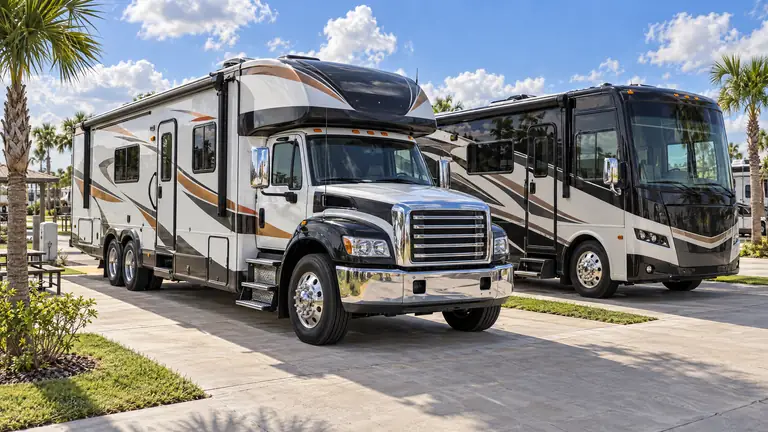 GuideSuper C vs. Class A diesel pusher: which heavy hauler fits?Truck-chassis Super C vs diesel pusher compared.Read more
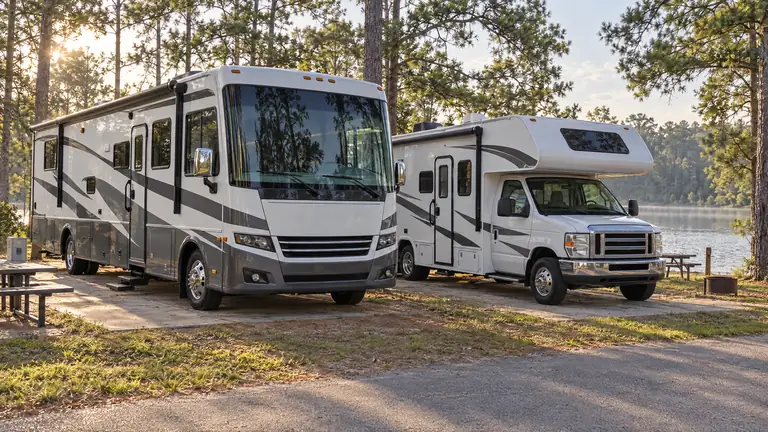 GuideClass A vs. Class C motorhome: the real differencesSize, chassis, driving and upkeep compared.Read more
 GuideHow many miles is a lot for a motorhome?Engine life, generator hours and low-mile risks.Read more
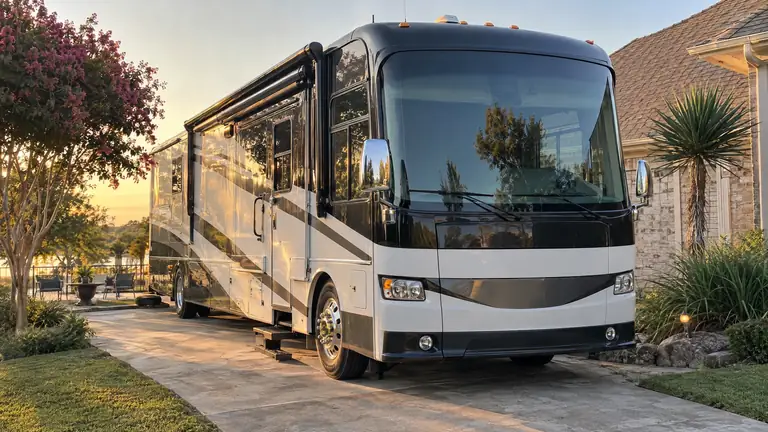 RV typeSell your Class A motorhome in HoustonGas coaches and diesel pushers, running or not.Read more
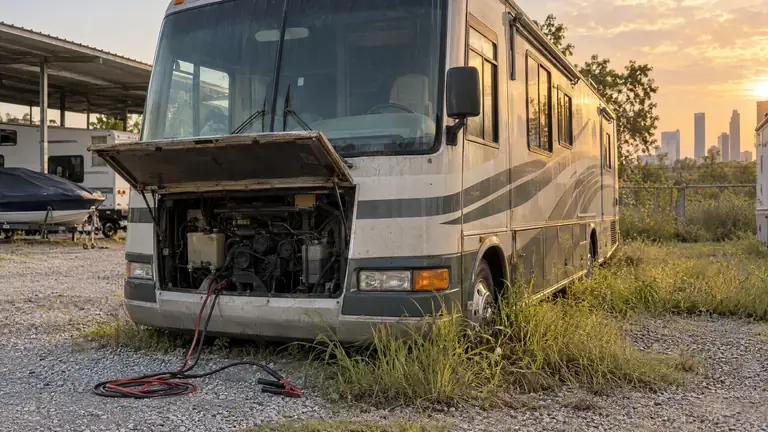 SituationSell a motorhome that doesn't runEngine, transmission or electrical trouble, and we tow it.Read more
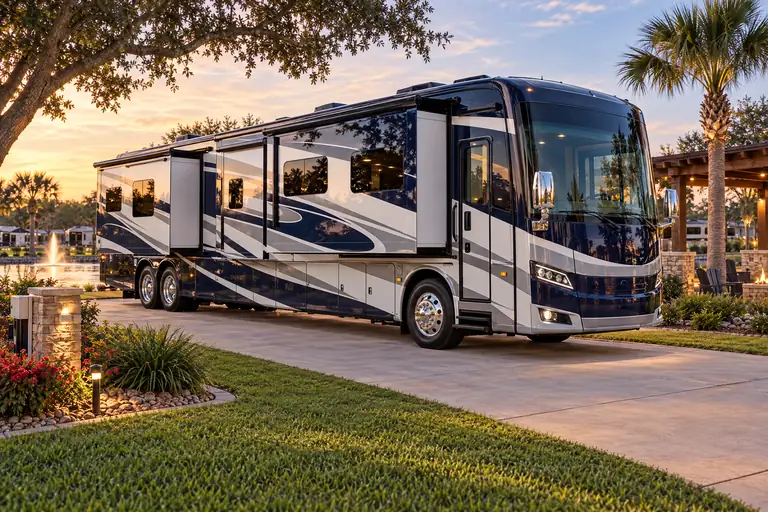 MakeSell your Newmar Motorhome in Houston for cashDutch Star, Bay Star, Mountain Aire and other Newmar models.Read more
Ready when you are
Get a real number for your RV, not a listing estimate.
Send a few details and photos. We'll come back with a cash offer, and if it works for you, we handle the paperwork and the pickup.